One of the biggest data centres in the world is being planned on Scottish soil. The plans for it are so obviously bullshit the developers must think we're fools.
Locals are rallying against the CATO, an allegedly "net zero", "zero waste" data centre which will "harvest rainwater" while providing "data sovereignty".


I grew up in a Scottish region scarred by extractive infrastructure: quarries, coal mines, gas plants, coal plants, and one massive oil refinery. Gradually, much of that infrastructure has been decommissioned and shut down. The coal mines are long closed, the coal plant no longer running, the gas plants are being decommissioned and even the oil refinery is closing its doors. For a brief moment—of really only a few months—it looked like Fife would be extraction-free for the first time in over a century. But now a new industry has got its claws into our rich land: "artificial intelligence".
One of the biggest data centres in the world is being planned not ten miles from where I grew up, to the horror of local residents. The CATO data centre, named as such after a Roman statesman in an abysmal attempt to wash the project as an intelligent and thoughtful investment, proposes to take over agricultural land, woodland, and the ruins of a castle, next to the small, rural village of Auchtertool. The proposed site dwarfs the village, bumping right up against its boundary. The developers say the infrastructure will be in-keeping with the local surroundings but the plans submitted include a building longer than the length of the village stretching 35 metres into the air.
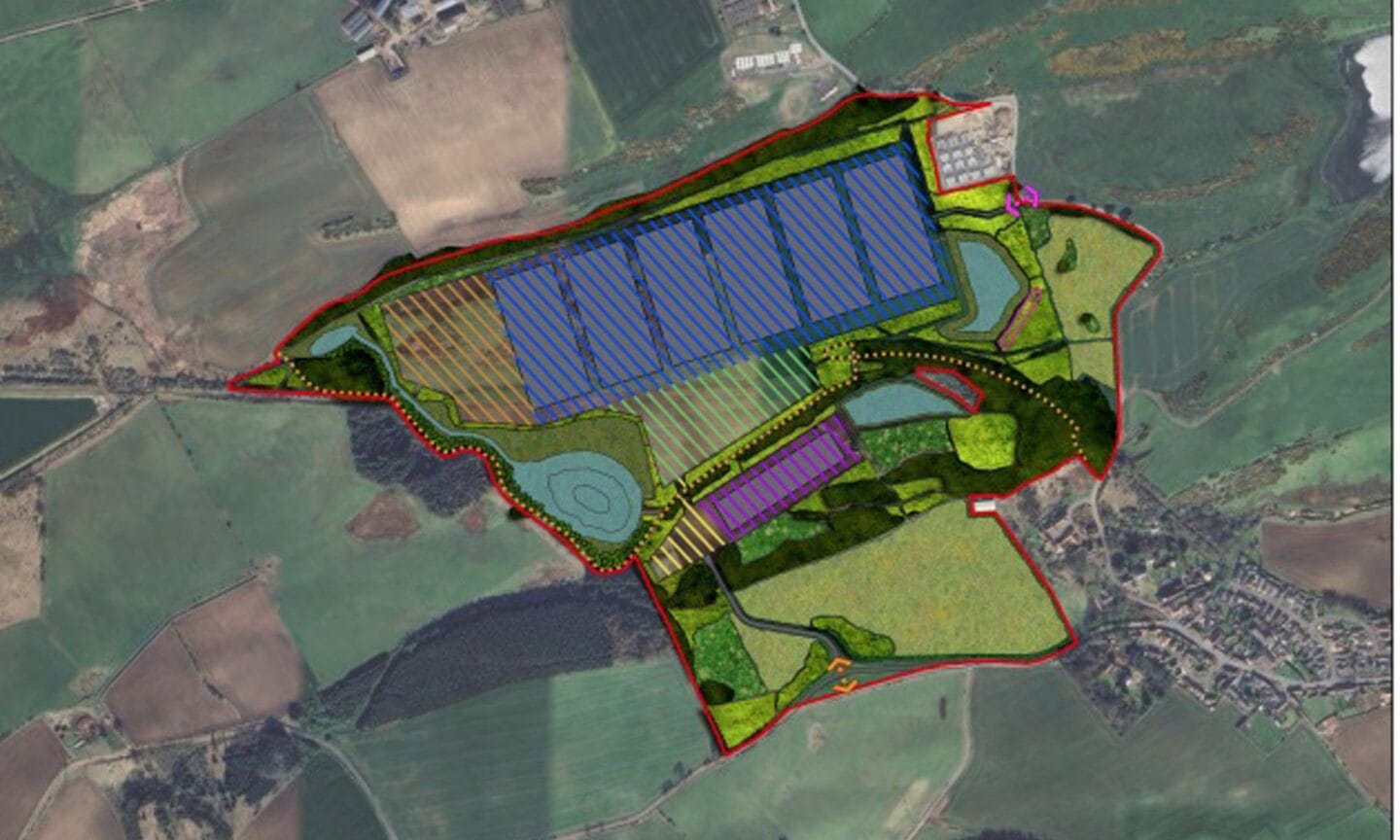
The data centre has been proposed by the ILI Group, a renewable energy property developer who has a habit, said a research librarian at the public meeting, of building out renewable infrastructure in Scotland and selling it off to foreign bidders. They claim that the data centre will be "zero waste" and "net zero", powered by Scotland's enormous wind energy capacity. Scotland does currently overproduce electricity to the extent that enough we could power every home in the country twice over. The data centre would use half of that—50% of residential demand—meaning there arguably is enough green energy to run the thing. What the developers fail to mention is that data centres cannot rely on renewable energy because of the intermittency problem—sometimes the wind drops, or the sun doesn't shine, or the waves don't thrash, and when that happens, and not enough electricity is produced, data centres need a back-up. That involves turning on diesel generators. It was this very problem that made it more economically viable for Microsoft to begin building their own nuclear power plant for their own proposed data centre.
Where will the enormous amounts of diesel come from for CATO? And who will pay the cost? And whose fuel will be redirected so that this mammoth fire hazard—built right next to Mosmorran gas plant which is slowly being decommissioned—can reliably stay on? CATO is being sold to Scotland as promising data sovereignty, but it will force a country which is nearing energy independence through electricity production to rely on the whims of the global fossil fuel trade.
A particularly laughable claim is that the data centre will only use the equivalent of 239 residential homes' annual water usage (around 2 million litres). Perhaps ILI Group have a secret technology that is unavailable to the rest of the market, because the average water use for these data centres is 11–19 million litres per day. Their ludicrous claims do not stop there. In their planning documents, they write that they will collect the water they need by "harvesting rainfall". Scotland is indeed a wet country, but not that wet. How fortunate for the developers that they happened to choose a site right next to a loch which has been used to supply 12 million litres daily to the gas plant for decades—you know, just in case.
The ILI Group claims that the data centre will create thousands of local jobs but, as one tech insider said at last week's public meeting, "data centres are built to run lean". In the purest vision of Silicon Valley, these mammoth structures only require a handful of staff to run, and engineering problems are often outsourced to foreign experts. Almost every single part of the data centre's construction and management will no doubt be supplied by foreign companies, from the hardware to the expertise. The only thing that will be required of Scotland is our arable land, freshwater, and political weakness.
The ILI Group also insists that data centres—and this is but one of three planned across the country—are requisite national infrastructure. The Scottish Government has fallen in line with Silicon Valley's vision for the future and has developed an "A.I" plan for the future. Despite the very many dissident voices questioning why so-called artificial intelligence is a necessary industry at the public meeting, nobody in charge seems willing to challenge the techno-oligarchs who stand to make trillions by appropriating our resources, cutting our jobs, and cementing their grip on political power. "Artificial intelligence" is driving a socio-political change that none of us consented to. It is undermining democracy, increasing the wealth gap, worsening racist and sexist biases, and threatening our already endangered ecosystems. The benefits to the everyman are yet to be seen—perhaps the hope is that depending on ChatGPT for our every thought process will atrophy our brains to the extent we no longer notice how our collective future is being ripped away from us.
The icing on the cake is that Fife Council, the local government body who has approved the first steps of the application, is not even demanding an Environmental Impact Assessment for the enormous site. In Scotland, these supposedly necessary pieces of national infrastructure do not yet have national legislation to regulate them. This loophole is what has seen over twenty planning applications for data centres be recently submitted on Scottish territory. Edinburgh Council did the honourable thing and rejected theirs, for lack of clear information as to the energy requirements and local impact. Fife Council have no such honour, it seems. The paltry Environmental Report supplied by ILI Group has cleared their conscience enough it seems—despite great swathes of it being redacted (bizarrely, the planning proposal is no longer available online).
Fifers are not stupid folk. Over 250 locals were packed into a tiny village hall last week to hear the Chair of the Auchtertool Community Council lay out the proposal, their objections, and the steps they are taking to resist it. The crowd then offered solidarity and advice on different stages of the process. Not a single person thought the data centre was a good idea. The hall filled with sardonic laughter at the mention of the water usage, employment opportunities, "data sovereignty", and the alleged net benefit to the environment. Those who spoke up from the crowd, alongside the tech insider and the librarian, included former Fife planning officers, parliamentarians, a biologist, a lawyer, artists and locals who have been involved in decades-long campaigns against Mosmorran and fracking. The hall pulsed with possibility. I spoke to the dangers of handing over our precious resources during a worsening eco-crisis to an industry which generates revenue for a handful of men who are actively trying to dismantle democracy. Robert spoke to the need for, alongside legal objections, spilling out onto the streets in protest. We told them of a Colombian community that has fought off a mine for two decades by dismantling the company's machinery. Cheers went up.
We are up against huge players. The Former Energy Minister for the UK and current adviser to the UK Government’s Board of Trade, Labour peer Brian Wilson, sits on the board of the ILI Group. He served under then-Prime minister Tony Blair, a man who is up to his neck in Middle East capital, foreign interests, and artificial intelligence projects. Blair has been pushing the current Labour government to adopt a.i. wherever possible—including the failed plans for a digital ID. Since leaving office, Blair has spent his years rubbing shoulders with autocrats all over the world. He helped secure Emirati cash for an environmentally disastrous plan to move Indonesia's capital. Those questioning his loyalties—and the dangers of his close ties to British government in such circumstances—are asking the right questions.
The CATO data centre has links to some of the most powerful people in the country—and perhaps the world. They are not the ones who will suffer the consequences of its creation. They will never be forced to live next to its heat, its noise pollution, its localised droughts. They will soak up all the economic benefits and call any localised harm to the environment and people an "externality" for which they cannot be held accountable. Then, one day, in the distant future, their descendants will manufacture yet another industrial revolution and impose their own violent vision of the world on our own descendants, the great-great-great grandchildren of the miners who believed their sacrifice was buying their children a better life. But as long as rich men dictate what happens on our land, our sacrifices will only ever buy better lives for them.
The people of Scotland deserve better than for history to ceaselessly repeat itself. We were locked out of our common wealth when the wealthy erected fences on our lands to keep us out. Every extractive innovation since has kept wealth flooding out of our communities: on coal trains, through pipelines, and now via The Cloud. And as that wealth flooded out, pollution flooded in—into our water, our lungs, and our local government.
Resisting this mammoth data centre is about so much more than protecting the village of Auchtertool. It is about resisting hundreds of years of colonial exploitation, and resisting the insidious implication that the future is out of our hands. There are no better hands than ours to create what we need where we are. There are no better voices to speak for ourselves where we are. And there are no better ideas for where we are than those that grow from the soil where, united, we stand.
Planet: Critical investigates why the world is in crisis. It is ad-free, paywall-free and 100% reader-supported. To show your support, leave a one-off tip. or become a paying supporter.


