To remember together is to resist
We cannot be ecological without confronting loss


I tell myself that I am in an urgent battle for a better future by working in the world of United States’ climate change policy. In 2026, the objective is clear: defend environmental regulations and policies that improve public health and protect our future. Our battle is not waged on the ground. It is waged in courtrooms and legal briefs, in white papers debating the future social cost of carbon dioxide and quantifying the damages of temperature rise in decades to come. This is how policies change; this is how we scale impact. But it is also how we hide from the present loss.
As fractions of degrees tick upward, as species disappear from our lands and our seas, as the foundations for our survival grow dimmer and less certain and the punishment from Mother Earth more vindictive, I feel compelled to act through fear for the future. I shake with fear that no statistical model, however informed with data on our emissions and our rate of deforestation, can translate into the ungraspable loss we will face from mass extinction and an unlivable climate. The relief of defended regulations is outweighed by the continual stress that no victory will ever overcome the inevitable destruction of more intense hurricanes, floods, heat waves, and wildfires.
But to truly mourn the loss we experience every day as human and non-human lives are lost to pollution and destruction is too damaging, too paralyzing. Mourning what we’ve lost means sitting in the reality that we’ve already lost irreplaceable beings with stories never to be recovered, that the walls of our biosphere are already crumbling around us and destroying the foundation upon which we’ve built our histories. If I mourn loss, I have to accept that I’ve lost control of what is happening and am powerless to change what has already happened. For that reason, I anxiously look to the future, preventing myself from truly experiencing the present moment.
Much of this comes from the inherent privilege of my position, the fact that living in the capital of the richest nation in the history of mankind affords a separation from pain where physical confrontations with the violence of nature’s wrath are replaced by the politicking of policy planning in air conditioned suites. But I do not doubt that the fear motivating me, my anxiety for the future, and my aversion to feeling the present is an opioid to avoid facing the pain of my lack of control over the loss we have already incurred. I tell myself that the worst is yet to come, and for that reason I must act to change what I can still change.
May we reach for the dead to show us that we are alive?
There are moments, however, when I am thrust into the crisis of our present reality. In my hometown of Houston, Texas, neighborhoods have been sliced by railroad and highway expansion, opening the arteries of communities for industrial pollution to seep in. The pollution, however, does not overflow indiscriminately onto each parcel of baked concrete webbed by an elaborate infrastructure dedicated to extracting and processing oil and gas. Rather, the architects of pollution deliberately choose their victims—the Black and the Brown, the poor and the vulnerable—justifying billion dollar investments in poison plants with promises of “development” for such communities. These lies can only travel so far. Residents know the truth: where the black tar flows, cancer grows. In the community of Fifth Ward, where residents have banded together to demand accountability for cancer caused by Creosote pollution, sustained advocacy has garnered national attention to the injustices suffered by its residents.
Hidden behind the contaminated train tracks in one such neighborhood lies a living reminder of what articulating the collective sense of loss encapsulates. The Houston Climate Justice Museum is a small parcel of swampy grassland, cleared and constructed in the hopes to raise awareness of how contamination has stolen lives from community members and as a meeting place for many of the community’s activists. It’s where they tell the story of Creosote poisoning through oral history. It’s where they communicate loss and build the community’s artistic graveyard. And it’s where they go to remind themselves of what they’re fighting for. Community members invite external folks like me to build our collective vocabulary for making sense of injustice and resistance. We know that the United States has routinely discounted Black and Brown bodies, but the museum communicates more viscerally, “this is what loss feels like.”
On a sweltering summer day last year, one exhibit held an encased shirt with the names of those that have been killed by pollution. I stood there for a while, their names lodged in my throat. I felt the heaviness of grief at human lives lost to the cruel indifference of corporate extraction and the sweat produced by the intensive work to memorialize loss. Death was not a distant future–death was here, and we were killing ourselves.
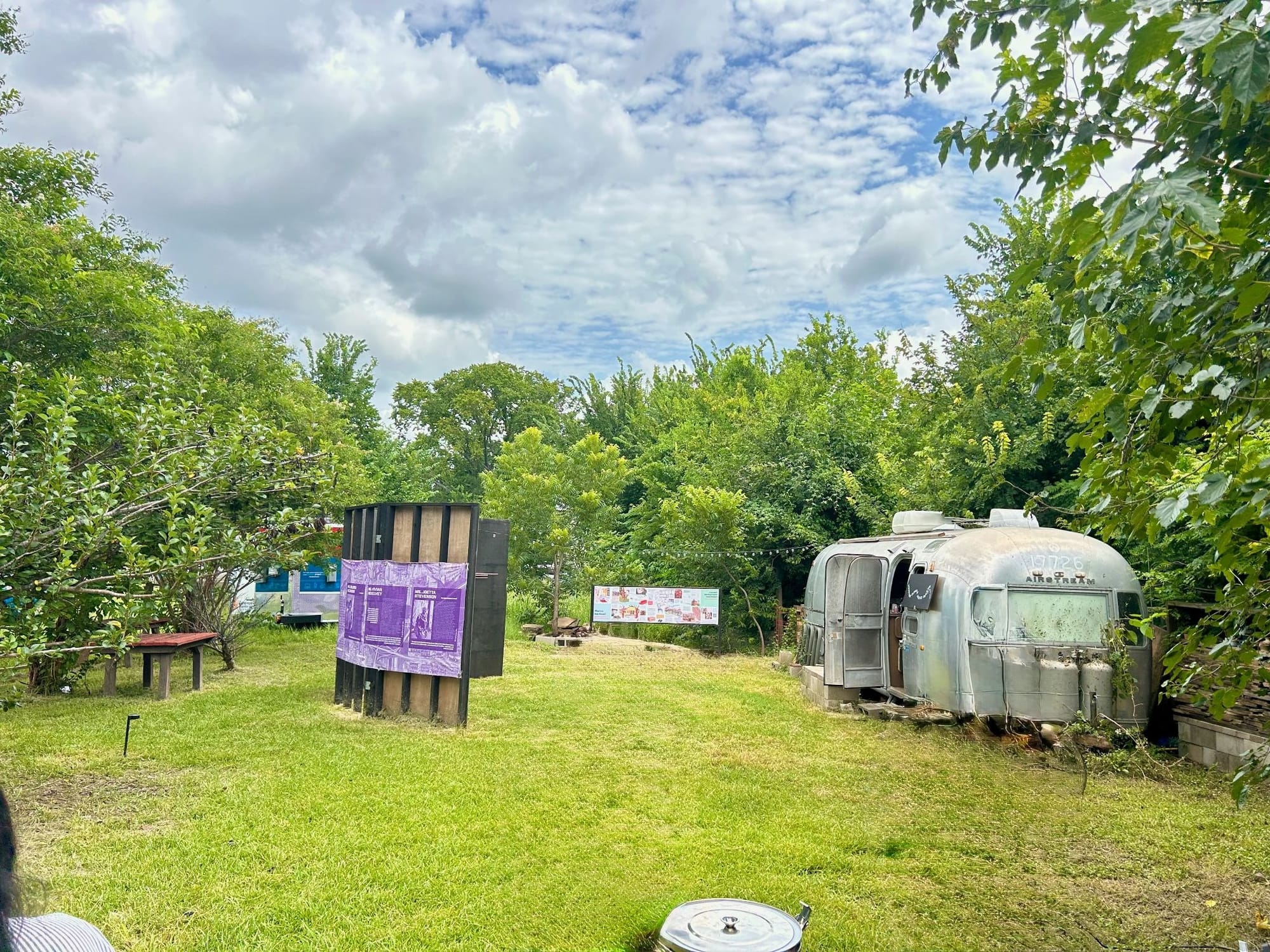
Temporarily understanding that reality was debilitating. But it was also undeniably beautiful, an irreplaceable moment of suspension in the acceptance of our circumstances and the decisions we could take going forward. The museum had not denied death on its doorstep—it had invited it gently, vulnerably sharing intimate loss with strangers because that was the only common language that we could speak when words failed us. Its message wasn’t something that could be rationalized in my brain, but rather something that physically occupied the space and held me tightly. Thinking about the future was a selfish act that allowed me to pretend as if I had control over what I could change. But being in the present, in a space created to share the stories of strangers, reminded me that our stories were irrevocably interwoven, that the bodies of the dead and the living were only separated by circumstance and chance. The crisis was not coming—the crisis was here. And yet, the museum could still create life in a place proclaimed dead by contamination by occupying space to bridge the stories of the living and the dead. Its decision to locate itself just meters from the railroad and continue convening people and communicating the stories of their friends and family were acts of defiance: We are not going anywhere. You may take our soldiers, but their stories give us strength. Amidst irrecoverable loss, we will create art.
To remember together is to be alive
The fear consuming me when hypothesizing uncertain futures makes it easy to discard the viscerality of past and present death and loss. But as the Wayúu people of the unforgiving Colombian desert had taught me, these states are worth holding onto. For the Wayúu, funerals are considered the largest family events, where hundreds if not thousands convene, including distant relatives who willingly slaughter their cattle and goats, far-flung friends who bring thousands of dollars of alcohol from hundreds of miles away, and grieving families who painstakingly construct customized tombs. The Wayúu typically hold two funerals for the perished, the first wake to bury the dead and the second wake five to ten years after to let go of the dead on their journey to their eternal resting grounds.
When attending the second wake hosted by one family I knew, I quickly realized that the days-long event was not a memorialization of the past: it was a window between the living and the dead. Women engulfed each tomb with their collective cries, tenderly cleaning the dry bones of ones they had loved. For but a moment, they sang the song of ephemeral grief, their connection so intensely saturating the air with the pain of not being able to recover what had been lost. The dead had been lost, gone on their way to the afterlife. But the alive remained, because to live is to remember together. Mesmerizing and terrifying, such a ceremony is only made possible by a belief that a history of a people could be maintained through collective artistic tradition, and that bonds of solidarity could be strengthened by gathering together in wonder of the brevity of life and the eternality of death.
The families at this funeral understood something that I could never arrive at through my future-facing disposition: that accepting the crisis—in this case, death—opens the door to togetherness and a shared language to experience being transfixed.
I’ve met warring families who have repaired relationships due to the sacredness of sharing space at a funeral and clans where the speed of trust moved at the speed of collective mourning. I’ve seen communities build empathy by sharing stories of resilience to hardship. Resource scarcity is endemic to the unforgiving desert that many Wayuu call home, with climate change exacerbating the damage brought by drought. Control over their future is an illusion: they cannot decide whether the rains will come in ten years. But choosing resilience in the face of change is their reminder that they are still standing. Many communities accept that their greatest power comes not from fixing crises but rather by making sense of them in community. For it is the shared emotion of being transfixed by crisis that affords humans the ability to find beauty in what we’ve lost. And it is finding beauty in what we’ve lost that shows us that we’re still here.
Holding our breath
I, and others like me advocating for change, are so focused on what we need to do to prevent future crises that we’ve lost sight of what lies below, behind, before us. The depths of the ecological crisis lie too deep for urgent thinking to shine a light on where to go next. But if we choose to appreciate a crisis like we appreciate art—holding our breath and sitting in the reality that we lack control to fix it—we can begin to make sense of it while holding on tightly to one another. Then we may find the strength to bear the crisis without the specter of despair-induced urgency.
Much of the ground surrounding the railroads in Fifth Ward is contaminated by a toxic plume of Creosote, but community members have recently begun experimenting with agriculture in the museum’s plot of land. It requires an immense strength to tend the soil of a ground that has poisoned brothers and sisters, to give back to a land that has taken life. But that is the essence of what a crisis demands of us. Because only in the beautiful, the terrifying, the sorrowful, may we find each other’s hands and re-tend our collective garden. Like a raging river, the ecological crisis has taken so much from us already. But we cannot let it sweep away our collective resilience in the face of loss, for that is much stronger than our anxiety for where the river ends. We must hold each other because it reminds us that we are still alive, that grief is our way of planting roots in a river we may not be able to dam, but in which we can still make life.
This piece was written by Rishab Jagetia in his personal capacity, and the opinions expressed in this article are the author's own and do not reflect the view of his employer.
Planet: Critical investigates why the world is in crisis. It is ad-free, paywall-free and 100% reader-supported. To show your support, leave a one-off tip. or become a paying supporter.


